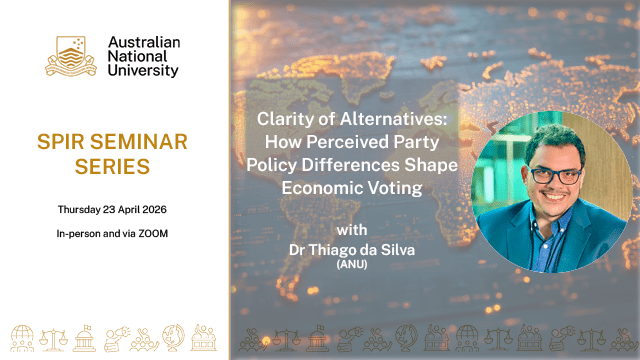
Economic voting theory posits that voters reward or punish governments based on their economic performance. While clarity of responsibility has been shown to condition this relationship, less attention has been paid to how perceived policy differentiation between parties shapes it. Dr Thiago da Silva develops a unified framework linking these informational conditions through the concept of clarity of alternatives, the degree to which voters perceive clear, ideologically distinct positions held by incumbents and challengers. He argues that voters' capacity to hold governments accountable depends on both dimensions of clarity, and derive testable implications for how perceived party separation, positional precision, and a composite index of the two-condition economic voting. Using CSES data across 41 democracies (1996–2021), he finds that party separation and the composite index amplify economic voting. However, rather than reinforcing each other, the two conditions partially substitute: parties' programmatic differentiation proves most consequential where responsibility is hardest to assign.
Dr Thiago Nascimento da Silva is a Senior Lecturer in the School of Politics and International Relations (SPIR) and the Deputy Director of the Australian Centre for Federalism at the Australian National University (ANU). He is also the co-chair of the Quantitative Methods Group at the Australian Political Studies Association. Thiago's research focuses on comparative politics, with a particular emphasis on political institutions and political economy. He is the co-author of the recently published books Voter's Perceptions of Party Brands (Cambridge University Press) and Learning to Govern Together in Representative Democracy (Oxford University Press).
Zoom meeting ID: 528 504 2235
Password: 8675309
This event was originally published on the School of Politics & International Relations website.
Location
RSSS Room 4.69 or Online via Zoom
Speaker
- Professor Dr. Alexander De Juan (University of Osnabrück)
Contact
- Richard Frank