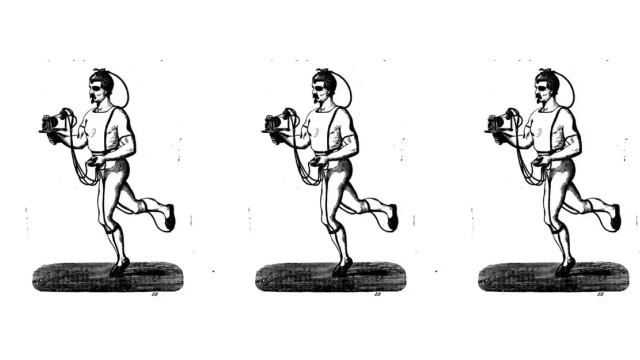
Georges Demenÿ, pneumatic measurement of the moving body, 1890s. Image courtesy of the Collège de France.
Experimentation has become one of the most dominant forms of knowledge production in use today, invoked by scientists, artists, activists, policy makers, and critical theorists alike to describe practices that generate new knowledge, enable new modes of expression, or transform existing conditions. How did this single concept come to acquire such a wide range of meanings, some of which are incompatible? Despites its current ubiquity, and the privileged position it occupies in just about every field of endeavour, the meaning and validity of experimentation as a particular kind of knowledge production are now largely taken for granted.
This presentation traces the social and historical conditions in which experimentation was established as a foundational mode of knowledge production through its application to human bodies. Existing scholarship has largely approached experimentation on or with the body through one of two lenses. Critical studies of science and medicine have tended to it with engineering, associating it with the manipulation, optimization, and control of life. Studies of the arts and critical theory, in contrast, have emphasized how experimental practices generate new possibilities for life, embodiment, and experience. This presentation puts these two ways of making bodies experimental into dialogue. Experimental bodies provide a particularly rich figure through which to examine these tensions, as the contested product of an engineering.
About the speaker
Elizabeth Stephens is Associate Professor of Cultural Studies in the School of Communication and Arts at the University of Queensland, and the author of four books, including Artificial Life: the Art of Automating Living Systems (2026), with Sarah Collins, Oron Catts, and Ionat Zurr, and Normality: A Critical Genealogy (2017), co-authored with Peter Cryle. She is the founder and convenor of the Australasian Health and Medical Humanities Network, and co-Editor, with Alison Downham Moore and Sheila Cavanagh, of Australian Feminist Studies.
This event was originally published on the School of Sociology website.
Location
RSSS Room 4.69, and Online (register for Zoom details)
Speaker
- Associate Professor Elizabeth Stephens (UQ)
Contact
- Thao Phan