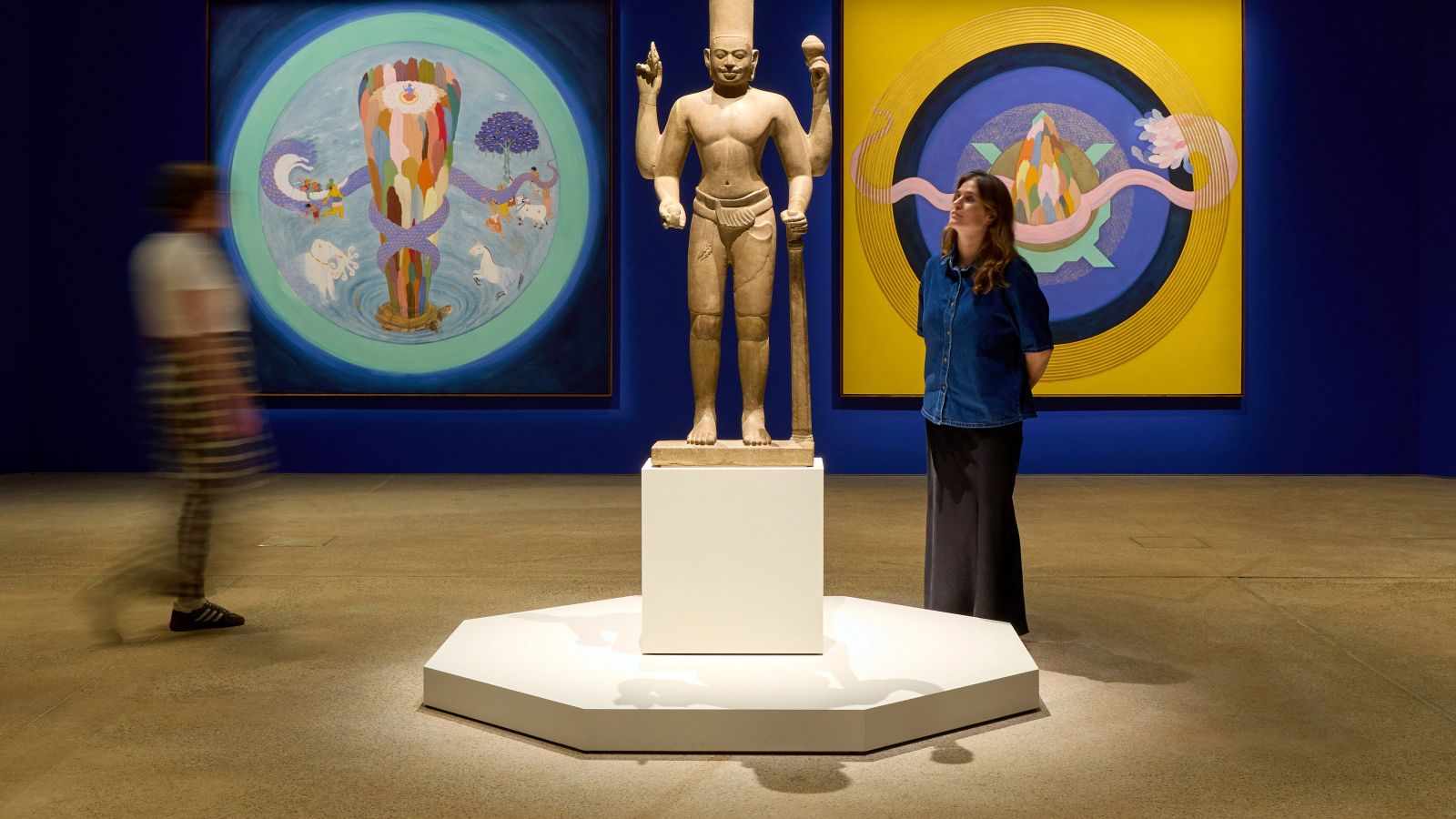
Avatar: Forms of Vishnu, on now at the Art Gallery of New South Wales, is the first major exhibition in Australia dedicated to the Hindu deity. (Supplied: AGNSW/Jenni Carter)
ANU Associate Professor Chaitanya Sambrani has co-curated an exhibition that sees the avatars of Vishnu in new light
An animated cosmic ocean marks the entrance to Avatar: Forms of Vishnu at the Art Gallery of New South Wales, marking a passage into the world of the exhibition. The title comes from the Sanskrit word avatāra, meaning “descent”. In Hindu traditions, Vishnu is the deity responsible for preservation who takes different forms to restore balance when the world falls into disorder. Developed over millennia, the rich iconographies and narratives of Vishnu’s stories remain ethically, spiritually and politically meaningful for many hundreds of millions across South and Southeast Asia.
Sambrani, Associate Professor in Art History and Curatorial Studies at the ANU School of Art & Design, co-curated the exhibition with Melanie Eastburn, Senior Curator of Asian Art at the Art Gallery of New South Wales. Three years in the making, this collaboration between the ANU and AGNSW brings together 200 works spanning 1,500 years, sourced from 12 museum collections across Australia, Cambodia, India, Switzerland and the UK. Including the work of nine contemporary artists, the exhibition is accompanied by a major publication presenting new scholarship by Australian and international art historians and curators. Avatar is the first Australian exhibition devoted to Vishnu and the AGNSW’s largest presentation of South and Southeast Asian art in more than 20 years.
In an essay for the exhibition catalogue, Sambrani examines how new meanings and ways of interpreting Vishnu have been layered onto older beliefs and practices, and how these dynamic traditions continue to inform contemporary life. “It’s really important to highlight the plurality of Indian tradition,” he told the Sydney Morning Herald, adding, “the mythological is especially significant because it has a relationship with who we are and what we do. It’s…resonant because of what people living today make of it.” As Sambrani told ABC Arts, Vishnu’s many forms leave room for different ways of understanding the world and ourselves.
The exhibition gives that plurality physical form, highlighting the diversity and innovation that characterise traditional and contemporary practices across South and Southeast Asia. An early 9th-century Cambodian sculpture shares a room with paintings by contemporary artist Desmond Lazaro. His work revisits the churning of the ocean of milk, a creation story in which Vishnu appears as a tortoise to support a mountain while gods and demons seek the nectar of immortality. Elsewhere, a 13th-century sculpture of Vishnu’s man-lion form is framed by a new installation in cotton and silk by artist Sumakshi Singh. Ancient objects and contemporary works show how artists continue to interpret the stories, highlighting the vitality and resonance of traditions that cross geographies and defy narrow definitions of cultural belonging and identity.
Avatar: Forms of Vishnu is showing at the Art Gallery of New South Wales in Sydney until 5 October 2026.