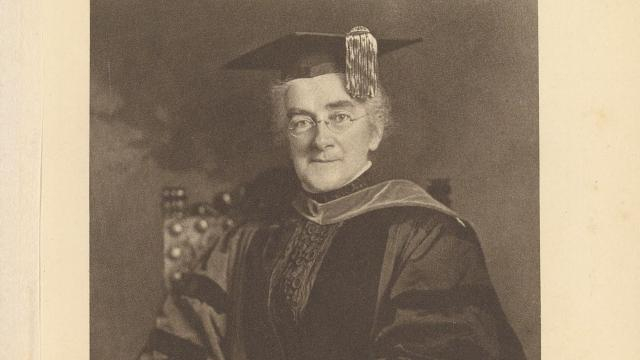
Image: Portrait of Ellen Henrietta Swallow Richards in academic regalia, from The Life of Ellen H. Richards, 1912. Science History Institute.
In the first half of the twentieth century, the new science of controlled heredity, “eugenics,” was shaped from the beginning to the middle of the twentieth century by another new science of controlled environments, the science of “euthenics.” Euthenics, Women, and the Making of Better Environments describes the founding of euthenics by Ellen Henrietta Richards, one of the most significant American scientists of the late-nineteenth century, well known as a key founder of Home Economics. Richards’ euthenics grew out of Progressive Era demands for the scientific management over environmental issues like life and labor, health and hygiene, sewage and sanitation. This talk unites women’s history, environmental history, and the history of science to show how euthenical conceptualizations of environments shaped ideas and practices of eugenics, heredity, nature, and nurture. I reinterpret American eugenics as a program seen on all sides to be in competition with a now-forgotten, environmentally focused rival, euthenics, and so throws new light on one of the most important social movements of the twentieth century. Through euthenics, we see a time when the environment held the potential for change.
David Munns is a professor at John Jay College of the City University of New York, and a graduate of ANU, Sydney University, and Johns Hopkins. He has authored six books, taught nearly 10,000 students, and was chair of his department. His talk is from his forthcoming book, due out next year, Euthenics, Women, and the Making of Better Environments.
Join Zoom Meeting: https://anu.zoom.us/j/88902124291?pwd=f9S8I7GgtJwog6OkB0E3BQTxq77WdN.1
Meeting ID: 889 0212 4291
Password: 814181
This event was originally published on the School of History website.
Location
Lectorial 1 (room 1.21) and online
Speaker
- Professor David Munns
Contact
- Sameera Chauhan